by Thomas Freitag
From protecting the spine to a stylish design feature. An article on the history and significance of the headband.
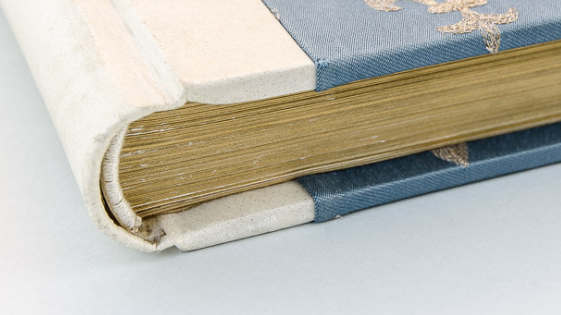
Anyone holding a high-quality book in their hands and looking down at the spine from above will almost always find it. A headband is not a ribbon for reading or marking pages. A ribbon serves as a bookmark and helps you quickly find a passage in the book. The headband is a fine fabric ribbon that nestles around the spine like a silkworm and adorns it as a decorative element.
The technical term ‘headband’
The term ‘headband’ is derived from the Latin word ‘caput’ (head) or its diminutive form ‘capitellum’ (little head / chapter). In bookbinding terminology, the upper cut edge of the book is referred to as the head and the lower edge as the foot. The ribbon – which is now machine-woven but was formerly handcrafted – closes the gap between the spine and the cover.
Originally, ‘kapitell’ referred to the upper cap of columns in architecture, such as those found in churches and palaces. In the world of bookbinding, this term was applied in the Middle Ages to the decoration of the book block’s spine.
Even though a headband is attached at both the head and the foot, historically the term referred to the upper head end.
The function of the headband
From a protective to a decorative function: the headband is an integral part of a well-preserved book, even though in today’s industrial production it no longer serves any purpose other than decoration. In traditional bookbinding, the headband was not simply glued on as it is today, but was sewn by hand using strong twine around a core (made of hemp cord, string, parchment or leather) directly to the individual quires of the book block. This served to stabilise the book, securing the sheets right up to the trim and preventing them from tearing when a heavy book was pulled from the bookshelf. Books in those days, due to their wooden covers and considerable size, were not only substantial in terms of content but also had to be bound sturdily.
In today’s industrial production, as mentioned, the machine-woven headband serves primarily as a decorative feature. It neatly conceals traces of glue, the sewn-in strips and the gap between the book block and the cover. It is also used as a design element and, when coordinated with the ribbon marker and endpapers, creates interesting design accents.
In artisanal production, the book spine is still embellished today through intricate craftsmanship using hand-embroidered headbands or genuine leather headbands.
Like the German term ‘Kapitalband’, the Italian ‘il capitello’ also derives directly from the Latin ‘capitellum’ (little head / chapter) – referring to the top of the book. This is different from the French equivalent, ‘la tranchefile’. The word is composed of the French ‘tranche’ (book edge / book cut) and ‘filer’ or ‘fil’ (thread / to spin, to thread) – literally, therefore, a thread band running along the book’s edge.
Every book deserves a fine headband!